
Written by Ana Brandusescu, Research and Partnerships Advisor, GODAN
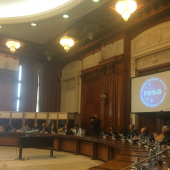
Earlier this year I had the opportunity to be on the open data panel at the Annual Bond Conference in London, a global development event. The panel included Sarah Johns (Bond), Dan Marshall (International Alert), and Fiona Smith (Open Data Institute), moderated by Claire Melamed (Overseas Development Institute). It was a compelling conversation. Partnerships, working groups, cross-sector collaboration, private sector involvement, local usability and the farmer’s voice, were all key points addressed in the Four Things to do with Open Data session.
As GODAN is a network of networks, partnerships are at the heart of what we do. Given the rapidly growing partner base, not only do we collaborate across the agriculture sector, our network spans data producers, data consumers, data decision makers via governments, research institutions, academia, NGOs, and private sector. Their roles and the types of data they produce and consume often overlap. GODAN consists of not only public-private partnerships, but also public and private partnerships.
In this session, I realised more than ever the necessity of working groups for like-minded people to share their experiences and advance their efforts. GODAN has launched a working group to explore the nutrition data gap, and will soon launch the Agriculture Sector Package working group that will support the development of the agriculture sector package, a policy resource that will provide guidance on how to make open data available, support the use of open data, and data interoperability.
A wider unifed effort
This is part of a larger effort led by the International Open Data Charter on developing open data sector packages. ODI and GODAN are planning a workshop on the Agriculture Sector Package at the GODAN Summit and a session at the 4th International Open Data Conference. The anticipated launch for the package is at this year’s OGP Summit in December. Other working groups being formed by GODAN include Data Infrastructure, Data Rights and Responsible Data, Kenya Data Integration, and Soil Data. What unites our partners is the awareness of common issues, problems to be solved, synergy and efficiency potential to be achieved through sharing knowledge, tools and open data, breaking fragmented approaches.
We use research to underpin our advocacy activities. For example, our partners Syngenta and the Open Data Institute are collaborating on a paper to help define a vision for the data infrastructures needed for the global agritech sector; recommending a way to nurture and build a sustainable data ecosystem. So what do companies get out of opening up their data? Comparability, a more reliable, comprehensive map of investment options, identification of new markets, common solutions, and new initiatives.
The private sector has incentives to share some of the plethora of quality data they own because businesses rely on data interoperability to reduce transactional costs; and link data standards on a global scale. Pre-competitive data exploration can also create an impetus for business where none existed before. Data producers are often data consumers who seek to use data freely, and deliver value added commercial products based on consumption and analysis of open datasets. There are many different types of data sharing. ODI’s data spectrum and GovLab’s shades of openness are two valuable sources describing where and why open data is fit for business.
The politics of data
Some perceive data as neutral. It isn’t. Data is political. After all, we have entered the data revolution. However data demands engagement to release its power. We have to do something about it, make it accessible, nurture it, improve its quality, and help it turn into information which will one day become knowledge.
Data exists in some parts of the world but is absent in others. In some contexts such as global nutrition, what we know is often inadequate. Where it exists in such contexts it certainly can be messy and unstructured and accessibility may be a problem. The data revolution can and should move forward by convening governments, researchers, businesses, NGOs, among many others to agree on and support the availability of existing data and support new data collection to fill in the gaps and break new grounds in innovation for food security.
We need to be creative about the way traditional technologies for information dissemination are used, which are mainstream communication mediums in many communities. Radio, voice-technologies and SMS have already been seen to be part of meeting the challenge in making open data accessible. Policy approaches will need to be tailored to local cases and contexts: understanding which stakeholders need to be involved in making data flow, and ensuring that it supports sustainable development. We therefore must focus on capacity building - to use local knowledge and expertise along-side data specialists in order to understand local context and processes to collect and analyse data for improved decision-making and then build on new technology use.
New partnerships can bring together a completely new combination of organisations from different sectors around a key thing they all have in common, a desire to make more of open data for agriculture and nutrition. These, in turn, have the capability to find common ground, forming working groups to collaborate on new projects.
The private sector can provide expertise and bring their own incentives to help create interoperable, global standards through public-private sector collaboration. Civil society can advocate for open data and transparency. Governments can establish improved policies conducive to open data and knowledge sharing, creating incentives for all to open and share their datasets. Nonetheless, as the data revolution moves forward, we cannot forget the importance of assuring local usability and inclusion of the farmer’s voice, including smallholder farmers.
That is why disseminating open data information via traditional communication media such as radio, voice-technologies and SMS is crucial for improved outreach and inclusivity. At the same time, it cannot just be a one-way conversation; we must find new ways to facilitate dialogue and respond to user needs.
The open data movement is ten years old, yet we have much work ahead of us. We all agree that policy change and a culture change needs to happen to make open data work. We need to learn from one another’s experiences and share best practices, guidelines for using data, dictionaries and vocabularies, whatever it takes to build a common language and bring more partners on board to help tackle the difficult challenges we face.